

In Hawaii, shadows vanish at noon. Here’s the exact schedule by island for 2026.
Before you scroll, I sometimes share links for Hawaii spots I genuinely recommend. No extra cost to you, it just supports the site. Read our affiliate disclosure for info.
Audio overview on Lahaina noon
Hawaii is doing something this week that no other state in the country can do.
Twice a year, the sun passes directly overhead here. Not close to overhead. Exactly overhead.
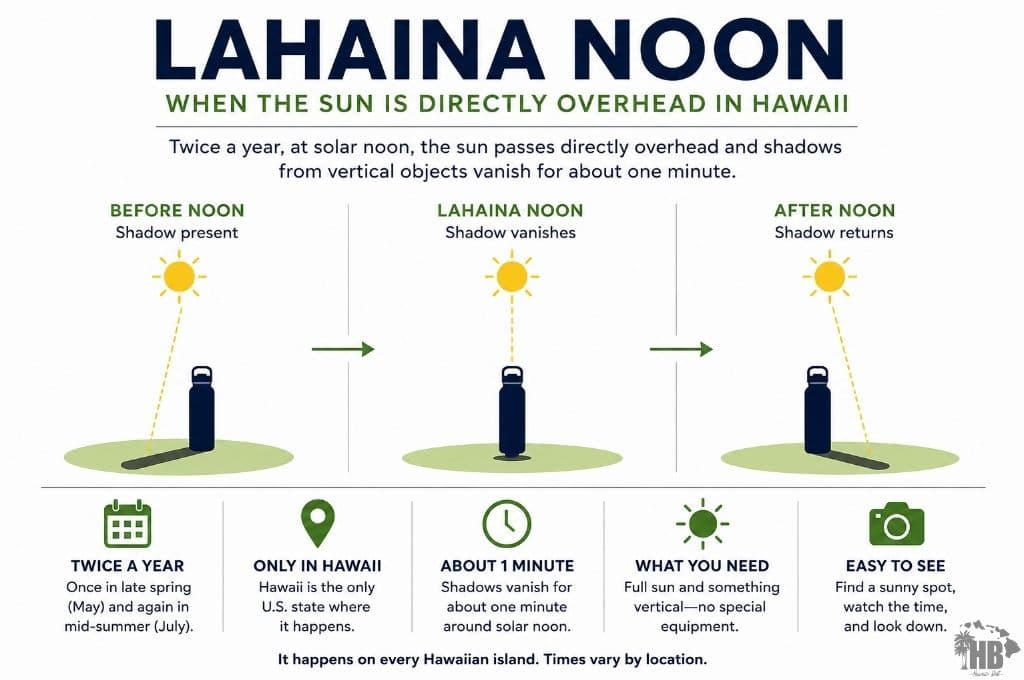
When it does, vertical objects stop casting shadows.
For about a minute around solar noon, your water bottle, a signpost, or your own arm will stand in bright sunlight with almost no shadow beneath it.
The phenomenon has a name: Lahaina Noon. It’s happening right now in the May 2026 island sequence, and Kauai is the last island up.
If you’re there on May 30, step outside around 12:35 PM in Lihue and look down.
Then look up that evening for the full moon rise. It’s a genuinely unusual day to be on the Garden Isle.
Quick Visitor Summary
What’s happening: Lahaina Noon is mid-sequence for May 2026. The Big Island passed it around May 18-19, Oahu hit it May 26, and Kauai is next on May 30 at approximately 12:35 PM in Lihue.
Who’s affected: Anyone visiting or living in Hawaii during late May or July 2026.
What to do: Find a sunny spot at solar noon. Set something vertical on the ground and watch the shadow disappear for about a minute. Bishop Museum tracks exact times at BishopMuseum.org/LahainaNoon.
Nothing to worry about: No closures, no fees, no special equipment. This is a sky event.
What to watch next: The full sequence repeats on all islands in July. Check Bishop Museum closer to your travel dates for exact times.
What is Lahaina Noon, and why does it only happen in Hawaii?
The sun rises in the east and sets in the west everywhere.
But most of the time, even at its highest point, the sun is still slightly to the north or south of directly overhead.
Shadows always lean in some direction.
Twice a year, for locations between the Tropic of Cancer and the Tropic of Capricorn, the sun crosses exactly overhead at solar noon.
When it does, shadows from vertical objects drop straight down, and for a brief window they effectively vanish.
Hawaii sits at roughly 19 to 22 degrees north latitude, right inside that tropical band.
The continental United States starts mostly above 24 degrees north, outside the tropics entirely.
Hawaii is the only U.S. state where Lahaina Noon happens.
The Bishop Museum in Honolulu gave the phenomenon its name, a nod to the historic West Maui town historically associated with intense sun.
Lahaina is sometimes described as meaning “merciless sun,” though Hawaiian language scholars note the full meaning is layered.
The museum’s J. Watumull Planetarium has tracked exact times by location across all islands for years and remains the go-to source for confirmed dates and times.
The zero-shadow window itself is short, roughly one minute around solar noon when conditions are ideal.
It’s not dramatic from a distance.
Up close, with something vertical in your hand and full sun overhead, it lands differently.
The 2026 Lahaina Noon schedule: exact dates and times for every Hawaiian island
Here’s the full May 2026 island sequence, sourced from Bishop Museum reporting:
|
Island |
Approx. Date |
Status |
|
Hawaii Island (Hilo side) |
May 18 |
Already passed |
|
Hawaii Island (Kona side) |
May 19 |
Already passed |
|
Maui / Lanai / Molokai |
May 24-25 |
Already passed |
|
Oahu (Honolulu) |
May 26, around 12:28 PM |
Already passed |
|
Kauai (Lihue) |
May 30, around 12:35 PM |
Coming up |
If you’re on Kauai right now or arriving before the 30th, this is worth building into your afternoon.
A few things to know about the timing:
It varies by location on each island. Honolulu’s time is slightly different from Haleiwa on Oahu.
On Kauai, the 12:35 PM time applies to Lihue. If you’re on the North Shore or the west side near Waimea, your exact zero-shadow moment will differ by a minute or two.
Bishop Museum’s website lists times for specific towns across each island, worth checking if you’re not near the main city.
May 30 also brings a Blue Moon. That evening, the third full moon in a four-full-moon season rises over the Pacific.
Kauai gets zero shadow at noon and a full moon at sunset, a genuinely memorable double-sky day if you’re paying attention.
For confirmed location-specific times on every island: BishopMuseum.org/LahainaNoon.
What should you actually do when the shadow disappears?
You don’t need a plan. You need timing and sun.
Find something vertical.
A water bottle standing upright works perfectly. So does a hiking pole, a pen, a post, or your own arm held straight.
You want something that normally casts a clean, obvious shadow.
Get into direct sun.
This won’t work in shade or on an overcast day. You need unobstructed sunlight.
Start watching about five minutes before solar noon.
The shadow doesn’t vanish all at once. It shortens gradually as the sun climbs toward overhead, reaches zero for roughly a minute, then slowly returns.
If you watch from 12:33 to 12:37 PM, you’ll see the full arc of it.
Look down at your own feet.
When you’re standing upright in full sun during Lahaina Noon, the shadow beneath you shrinks to a small circle, just your head blocking the sun from straight above.
It’s a strange, quiet sensation worth experiencing once.
For photos: Point your camera straight down at a vertical object and capture the before (clear shadow) and the during (almost nothing).
These work well as side-by-side shots or short videos and communicate the phenomenon clearly. Most people seeing it for the first time genuinely can’t figure out where the shadow went.
On Kauai, you don’t need a special trip for this.
If you’re spending the morning on the North Shore, Hanalei, Tunnels, Kilauea, you can head south to Lihue or Poipu by noon and catch it on the way to lunch.
Waimea Canyon visitors can note their specific-location time and watch for it mid-trail if the timing lines up.
If you’re looking for other experiences on Kauai with that same “you can’t do this anywhere else” quality, Unique Kauai Activities: 5 Experiences Actually Worth Your Time is a solid starting list.
And if you want to understand the cultural layer behind moments like this, 17 Unique Kauai Cultural Activities and Traditions gives you the context that makes a moment like this land differently.
July round: your second chance on every island
Not in Hawaii right now? Heading there in summer? You haven’t missed it.
The sun crosses directly overhead twice per year at every tropical latitude, once as it moves north toward the June solstice and once as it moves south again.
For Hawaii, the May sequence runs roughly south to north, Big Island first, Kauai last.
The July sequence runs the same islands in roughly reverse order.
Exact July 2026 dates were not yet published in Bishop Museum’s confirmed schedule as of this writing, but the July round typically falls mid-to-late in the month for most islands.
This gives you something most sky phenomena don’t offer: a legitimate second chance.
If you’re visiting Maui in late July or landing on Oahu for a summer trip, Lahaina Noon will come to you. You just need to know it’s coming.
For the broader summer picture, Hawaii in June covers weather, crowds, and what’s open.
And if you’re still deciding when to go, Best Time to Visit Hawaii in 2026 lays out the full seasonal breakdown with crowd and cost context.
The bottom line for Hawaii travelers
Lahaina Noon isn’t something you plan a trip around. It’s something you plan 20 minutes around, if you happen to already be there.
No tickets. No entry fee. No drive to a trailhead or reservation window that opens months in advance.
Just full sun, something standing upright, and enough awareness to look down at the right time.
The question isn’t whether it’s worth seeing.
It is. Hawaii is one of a handful of places on the planet where this happens, and it’s the only state in the U.S. where it does.
That’s a fact most visitors leave Hawaii never knowing.
Now you know. Set your alarm for May 30 if you’re on Kauai.
And if you’re heading there in July, check the Bishop Museum schedule when you land. The shadow will find you.
FAQs
What is Lahaina Noon?
When does Lahaina Noon happen in 2026?
What time does Lahaina Noon happen on Kauai in 2026?
Does Lahaina Noon happen on every Hawaiian island?
How long does the zero-shadow moment last?
Do I need to go anywhere special to see it?
Can you see Lahaina Noon from the mainland United States?
When is Lahaina Noon in July 2026?
RECOMMENDED POSTS

Hawaii Holiday Bookings Are Falling Behind. Should You Book Now?
Some Hawaii hotels report holiday bookings falling behind last year’s pace. Could this mean better deals for travelers? Here’s what to know before booking.

Aloha Tower’s Observation Deck Reopens After 5 Years Closed. But the Work Isn’t Finished.
[dssb_sharing_buttons columns="5" icon_width="fixed" alignment="left" icon_color="#000000" use_custom_icon_size="on" icon_font_size="16px"...

Renting a Car in Hawaii? An AI Scanner Doesn’t Replace Your Own Photos
[dssb_sharing_buttons columns="5" icon_width="fixed" alignment="left" icon_color="#000000" use_custom_icon_size="on" icon_font_size="16px"...
Bryan Murphy is the creator of Hawaii's Best Travel and host of the Hawaii's Best podcast, a top-30 U.S. travel podcast with 700,000+ downloads and a 4.9-star rating from 280+ reviews on Apple Podcasts. A Certified Hawaii Destination Expert and member of the Hawaii Visitors & Convention Bureau, he helps visitors plan more meaningful trips to Hawaii with practical, respectful guidance. His work has been featured in Travel + Leisure, National Geographic, Yahoo!, Simple Flying, USA Today, Parents, and Fox.