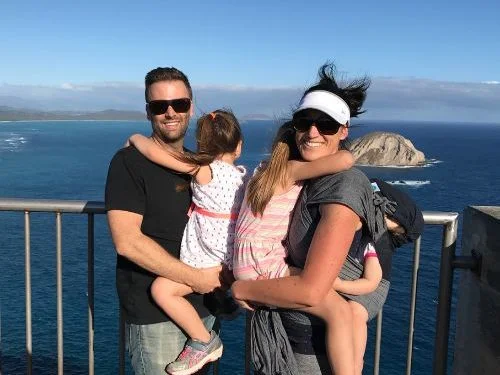

5 Hawaii Family Travel Mistakes Most Parents Realize Too Late
Before you scroll, I sometimes share links for Hawaii spots I genuinely recommend. No extra cost to you, it just supports the site. Read our affiliate disclosure for info.
Listen to the full podcast episode:
In this episode, we cover:
- Why the ocean in Hawaii feels safer than it actually is, even for parents who grew up near the water
- A close call Bryan had with his own daughters when the ocean floor dropped off just steps from shore
- Why brown water after a storm can carry more than mud, including bacteria, sewage, and chemicals washed down from miles away
- The real time cost of island hopping with kids, and why a “quick” inter-island flight can eat half a day
- Why the cheaper hotel isn’t always the better deal, and how location affects weather, drive times, and ocean conditions
- The reservation windows you can’t miss, including Hanauma Bay, Haleakala Sunrise, and Diamond Head
Your task for today: Spend 15 to 20 minutes looking up the reservation rules for one Hawaii spot on your list, like Hanauma Bay or Haleakala Sunrise, and note exactly when tickets are released so you don’t miss the window.
You’ve spent the money and done the planning. You want the beach days, the views, and memories that actually feel worth it.
The truth about Hawaii family travel mistakes is that yes, a few avoidable choices early in your trip can cost you a full day or worse.
I’ve made some of these mistakes myself over 16 years of bringing my own kids to Hawaii, and I see the same Hawaii family vacation mistakes trip up other parents again and again.
By the end of this article, you’ll know exactly what to watch for and what to do instead.
Mistake 1: Treating the Ocean Like a Mainland Beach
I grew up around Southern California beaches, from Huntington to San Diego, so I felt comfortable in the water. My first trip to Hawaii surprised me anyway. The water felt warmer and more inviting than home. But that comfort can be misleading.
I remember wading near shore with my daughters, who were younger and not strong swimmers yet. I took a few steps out, and the ocean bottom dropped off fast, right from underneath me. I wasn’t far from the beach at all.
That’s the real risk. A kid can be a strong pool swimmer and still not be ready for Hawaii’s currents, shore break, uneven footing, or sudden drop-offs.
Even snorkeling counts as an ocean activity, not a casual pool float.
My advice: stick to lifeguarded beaches, ask the lifeguard about conditions before getting in, and ease young kids into the water slowly. Beautiful doesn’t always mean safe.
Mistake 2: Ignoring Brown Water After Rain
This one came up a lot after recent Kona low storms hit Oahu. Rain in the mountains or valleys can affect beaches miles away, even if you’re standing in sunshine.
After heavy rain, streams and ocean runoff can turn brown or murky, and that water can carry bacteria, sewage, chemicals, and debris washed down from higher ground.
The mistake is thinking the sun is out now, so it’s probably fine. I always say to give streams and waterfalls space after rain, since wet rocks and rising water levels are real hazards with kids around.
If conditions look off, change the plan.
Grab lunch in town, do a scenic drive, or find a different lifeguarded beach instead of forcing a waterfall stop because it was on the itinerary.
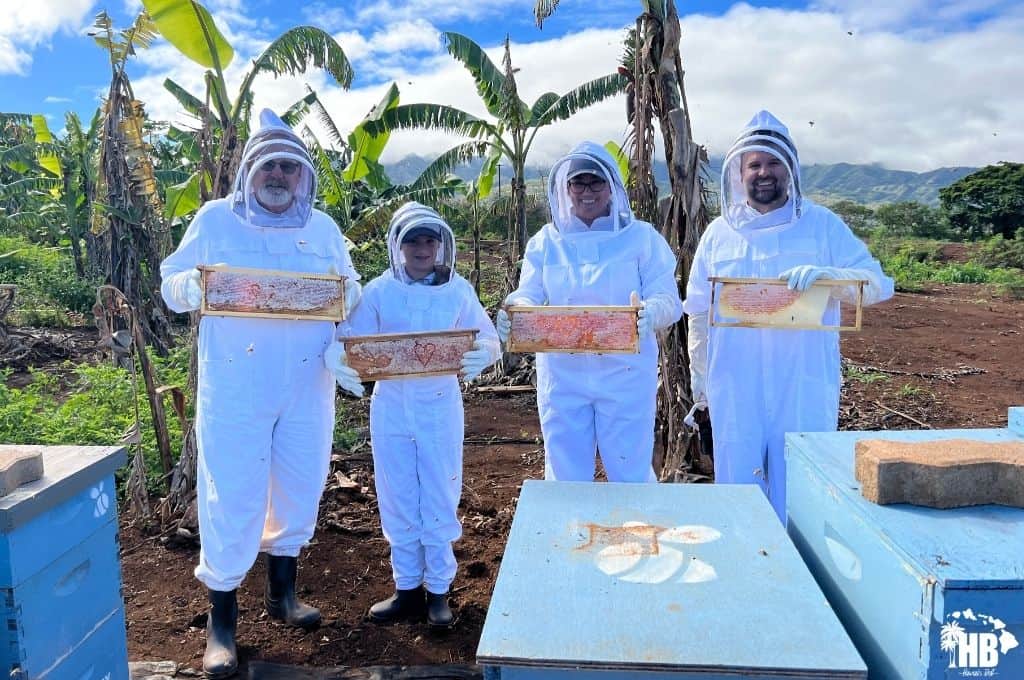
Some of my family “beekeeping” at Hi Honey Farms
Mistake 3: Trying to Visit Too Many Islands
This might be the most common mistake I see. On a map, the islands look close together, so it seems easy to fit Maui, Kauai, and the Big Island into one trip. It’s not that simple, especially planning a family trip to Hawaii with kids in tow. I’ve gone deeper into the timing and tradeoffs in my guide to island hopping in Hawaii, if you want to weigh your options before you book flights.
A short inter-island flight isn’t a quick hop. You pack, check out, return the rental car, check bags, get through security, fly, grab another rental car, and drive to your next place. By the time you’re settled again, you’ve lost half a day, and with kids it can feel like the whole day is gone.
My rule of thumb for most families:
- One island for about a week
- Two islands only if you have 10 or more days
- One big activity per day, not three or four stacked together
- One to two rest days built into the week, even on a single trip
That transition day between islands rarely feels like vacation. It feels like logistics.
Mistake 4: Booking Lodging for Price Instead of Location
Saving 50 dollars a night on a hotel or condo can feel like a smart move. Sometimes it is. But in Hawaii, location changes your whole trip more than people expect.
Weather and water conditions shift dramatically across the same island. On Oahu, the leeward side tends to be drier and the windward side wetter and greener.
On Maui, south and west Maui run drier while Hana and Upcountry Haleakala stay wetter and cooler. On the Big Island, the North Shore is lush but can see more rain depending on the season.
A cheaper room on the wrong side of the island can mean longer drives, rougher ocean conditions for little kids, and less convenient access to the beaches you actually planned around.
Before booking, check how far the property sits from the beaches and activities you care about most. What looks close on a map can be a 45 minute drive in reality.
If you’re still deciding between a hotel and a vacation rental, my breakdown of hotel or Airbnb in Hawaii walks through the tradeoffs for families.
Mistake 5: Waiting Too Long to Book Reservations
Hawaii has shifted into more of a plan-it-out destination over the last decade. Spots you could once just show up to now require reservations, and that can wreck a day faster than almost anything else on this list.
A few examples I flag in the episode:
| Spot | Reservation window |
|---|---|
| Hanauma Bay (Oahu) | Book online exactly 2 days ahead, 7am HST |
| Haleakala Sunrise (Maui) | First wave 60 days ahead at 7am HST, second wave 48 hours ahead |
| Haena State Park (Kauai) | Required for non-residents, limited parking |
| Diamond Head (Oahu) | Reservation required, sells out fast |
These tickets move quickly. If there’s a specific spot on your list, look up its reservation rules early and mark your calendar for the exact release time.
What You Need to Know Before You Go
- Ask the lifeguard about ocean conditions before letting kids in the water.
- Avoid streams, waterfalls, or ocean swims right after heavy rain.
- Book one island per week and add rest days, even on a packed schedule.
- Check how far your hotel actually sits from the beaches you plan to use.
- Plan reservations for spots like Hanauma Bay or Haleakala the moment you know your dates.
None of this is meant to scare you off a Hawaii trip.
If you only remember three things, remember this: slow the trip down, respect the ocean, and respect the place you’re visiting.
Our Favorite Hawaii Travel Resources!
🏨 Accommodations: We recommend Booking.com
✈️ Flights: For the cheapest flights, we use Skyscanner
🚗 Rental Car: We recommend Discount Hawaii Car Rental
🌋 Attractions: We recommend Viator
🌺 Luaus and Tours: We recommend Hawaii Tours
📱 Mobile Tour App: Our favorite is Shaka Guide
Listen to the Full Episode
Hear the full conversation, episode 241 of the Hawaii’s Best podcast, for the full breakdown.
And for a wider look at the slip-ups that trip up first-time visitors, check out Hawaii travel mistakes to avoid before you book.
For official safety guidance on ocean conditions, visit the State of Hawaii Department of Land and Natural Resources.
Resources mentioned in this episode:
Related episodes:
- 5 Mistakes When Planning a Trip to Hawaii
- Island Hopping in Hawaii
- Best Time to Visit Hawaii for Families
- Tips for Traveling to Hawaii with Teens
- Free Oahu Activities Your Kids Will Love
Related blog posts:
Planning a Hawaii trip and not sure where to start?
Get clear, personalized guidance so you can book the right island, experiences, and timing without second-guessing everything.
Get 1-on-1 Trip Planning HelpMore episodes:
Planning a trip to Hawaii? Join Our Facebook Group!
It’s the perfect place to ask any questions and to be inspired for your trip to Hawaii!
Don’t Miss the Next Episode of Hawaii’s Best
Join us each week for practical Hawaii travel tips, local stories, and cultural insights to help you plan a better trip to the islands.
Please follow on your favorite podcast platform:




If Hawaii’s Best has helped you plan your trip, we’d be grateful if you left a rating or review wherever you listen to the podcast.
Connect with Bryan
Looking for more Hawaii travel tips? Click here to browse all episodes of the Hawaii’s Best Travel podcast.
Transcript
241_5 Hawaii Family Travel Mistakes Most Parents Realize Too Late
[00:00:00] Family Trip Pressure
[00:00:00] Bryan Murphy: As a husband and dad. Three, I know how much pressure there is to make a Hawaii trip feel completely worth it. You’ve spent the money, you’ve done the planning you want the beach days, the shave ice, the views, the memories, all of it. But Hawaii has a way of exposing a rush plan fast, especially when kids are involved.
[00:00:18] Bryan Murphy: So in this episode, I’m gonna go through five family travel mistakes that we’ve made and that we see. See all the time and what to do instead.
[00:00:28] Five Mistakes Overview
[00:00:28] Bryan Murphy: Loha and welcome to Hawaii’s Best. I’m Brian Murphy, Hawaii, destination expert and your personal guide to planning an unforgettable trip to Hawaii. This episode is for parents specifically, and we’ve traveled with kids the last 16 years as long as we’ve had kids, so from diapers to toddlers to elementary age now with a couple teenagers and an.
[00:00:50] Bryan Murphy: Older elementary age kid. We’ve done all the stages, so I know how much work goes into planning a Hawaii family trip. You know, flights, hotels, rental cars, food, beach days, tired, complaining kids, hungry kids, and trying to make the whole thing feel worth the money you spent. Hawaii can be an incredible family trip.
[00:01:12] Bryan Murphy: That’s probably why you’re thinking about it, or you’ve been to Hawaii as a family. You know, it can be an amazing trip and the memories are completely priceless. But a lot of what trips families up is not always obvious. Sometimes it’s the calm beach, the extra island, the cheaper hotel or the reservation you thought you could book later once you get there.
[00:01:30] Bryan Murphy: So today I’m gonna go through five. There’s probably a lot more, but I’m gonna go through five Hawaii family travel mistakes.
[00:01:36] Ocean Is Different
[00:01:36] Bryan Murphy: So let’s start with the ocean, because this is a huge one. Mistake number one is treating the ocean like a mainland beach. And this is a big one because I don’t say this to scare you.
[00:01:46] Bryan Murphy: I say it because. I’ve made this mistake too. I, you know, I was born and raised in Southern California, still live here, so going to the beaches from Huntington, Newport, you know, all the way down to the beaches in San Diego. So I’m comfortable around the ocean. I know a lot about the different beaches here in Southern California, but the first time going to Hawaii.
[00:02:05] Bryan Murphy: What surprised me most about the beach is that, well, this isn’t a a a con, but a plus is that the water is just warmer. You’d be surprised maybe if you travel and visit Southern California and thinking the water’s gonna be warm, and it’s not. It’s not that warm. But surprisingly, the water. Was nice and refreshing and warm in Hawaii.
[00:02:24] Bryan Murphy: I remember that was like my first experience and it felt just so inviting and, and some of the beaches. What surprised me is that the bottom instead talking about Hawaii beaches, the bottom can drop off faster than you expect. I, I actually remember a time being in the water with my girls. They were a little bit younger and we were playing near the shore, and I walked out just a little bit further and then suddenly the bottom just kind of dropped off.
[00:02:45] Bryan Murphy: From underneath me. So I wasn’t that far offshore. Just a few steps. And that moment really kind of got my attention because my girls, they were closer to me and they weren’t strong swimmers yet at the time. And that’s something I think that’s important if you’re a parent. I want you to hear is that even if you’re familiar with beaches, Hawaii’s Ocean is just.
[00:03:04] Bryan Murphy: Different. The beaches are different, the current’s different. So a child can be a strong pool swimmer and still not be ready for the changing currents to shore break uneven footing. The dropoffs, like I mentioned, deeper water or just, you know, get getting tired faster than you expected. That’s something that I’ve always experienced when being out of the ocean, is that you tend to just kind of burn out a lot faster.
[00:03:28] Bryan Murphy: So snorkeling is another example here. A lot of people treat it as like a casual type of. Vacation activity, but snorkeling in Hawaii is still an ocean activity, obviously. And you need to be comfortable in the ocean, not just comfortable in a pool. Always, especially traveling as a family. Always choose lifeguarded beaches, you know, watch the water before getting in.
[00:03:49] Bryan Murphy: Ask questions, ask the lifeguard and what the conditions are like for that day. And with younger kids, ease into the ocean slowly because it is so critical and it’s so important. Hawaii’s beaches are beautiful, but beautiful doesn’t always mean safe. Respect is definitely needed when visiting any of Hawaii’s beaches.
[00:04:10] Rain And Brown Water
[00:04:10] Bryan Murphy: Mistake number two is something that I saw quite a bit after these Kona low storms went through, especially the island of Oahu, and that would be going near streams, waterfalls, or brown water in the ocean after it rains. This one is actually simple, but a lot of people miss it. Saw a lot of people going into the water and not heating warnings and advice in, in Hawaii.
[00:04:34] Bryan Murphy: Rain up in the mountains or valleys can affect places miles away. You may be standing in sunshine, but the water can still rise quickly from rain that happens somewhere else. After heavy rain, ocean water streams or runoff, they can turn brown or murky and that water can carry bacteria. Sewage, yes, sewage.
[00:04:55] Bryan Murphy: Chemicals, animal waste, debris, fill in the blank, whatever you can think of, can get washed up and end up in the ocean. So it’s not just dirty looking water, like just turned up sand or or dirt or whatever. It can actually make you sick. So the mistake is thinking, well, it rained this morning, but the sun is out now and it looks beautiful.
[00:05:16] Bryan Murphy: So we’re. Probably gonna be fine. That’s not always the case if it rained recently. Give streams and waterfall space, especially with kids. Wet rocks or slippery water levels can rise quickly and contaminated. Water is not something you want your family playing in on vacation well in any time. So if there’s been heavy rain recently just changed a plan.
[00:05:37] Bryan Murphy: Always look for, uh, local guidance. What officials are saying during that time, maybe just go get lunch, visit town. Do a scenic drive that day. Instead, find a safer beach with lifeguards if conditions allow. But don’t force, you know, a waterfall stop just because it looks good on the itinerary. Or don’t force a beach visit just because that’s what you had on the list.
[00:06:01] Bryan Murphy: Things change.
[00:06:02] Too Many Islands
[00:06:02] Bryan Murphy: Now moving to mistake number three. This might be the most common family travel mistake that I have seen, and that’s trying to do too many islands within one trip. I’ve done dedicated episodes about this all Lincoln below, just about island hopping. So on a map, the Hawaiian Islands, the chain looks a lot closer than you think.
[00:06:22] Bryan Murphy: So I get why people think, you know, you know, I could do. Maui, Kauai and the big island in one trip. They’re not that far apart, but island hopping is not as quick as it looks and especially, that’s why I have it on this list, especially with kids. Yes, the flight may be short, but that’s not the full day.
[00:06:40] Bryan Murphy: You have to pack. You have to check out. You have to drive the car back to the rental car. You have to return it. Check bags, go through security, fly wafer bags, pick up another rental car. Drive to your next place and check in. By the time it’s all done, you easily lose half a day. And with kids that can feel like a full day.
[00:06:56] Bryan Murphy: We’ve been there many times and I can attest that yes, it is at least a half a day of travel and settling back in. So that transition day usually does not feel like vacation. It feels like logistics, and it’s just travel. It’s just the way it is. So for most families. My recommendation is simple. One island for about a week.
[00:07:17] Bryan Murphy: If you have like say 10 days or more, maybe two islands could work. But be honest about your family’s pace. You really want to, especially if it’s your first trip to Hawaii or you’re thinking you’re probably not gonna go back anytime soon. I would. Highly recommend to going deeper into one island rather than spreading yourself out too thin across too many islands and, and once you’re on the island, you know, don’t stack the day with three or four major activities in Hawaii.
[00:07:46] Bryan Murphy: One big thing a day is usually the better plan, and also something that we’ve learned over years of traveling. Is building a rest day. Even if this is like your one and only trip to Hawaii and you feel like you gotta pack it in and you’re only staying on one island, still build in at least one to two rest days during that week and just take it easy and go slow.
[00:08:10] Lodging Location Wins
[00:08:10] Bryan Murphy: Now moving on to mistake number four that I wanna share is, uh, booking lodging for price instead of location. This is kind of a quiet one. It can cost you more than you think. For example, a family finds a hotel or condo that’s 50 bucks cheaper per night, and it feels like a smart move. Sometimes it can be.
[00:08:29] Bryan Murphy: In Hawaii, location matters a lot. Different sides of the same island can have very different weather, water conditions, drive times, and overall feel. So for example, on Oahu, the leeward side is usually drier, and the windward side is usually wetter and greener. Basically. That’s roughly. West is Leeward side and east is Windward side on Maui, south and West Maui tend to be a lot drier, whereas Hana is wetter.
[00:08:59] Bryan Murphy: Upcountry. Halala can be much cooler as well. And on Hawaii, the North Shore can be lush and beautiful, but it also can be wetter depending on the season that you’re traveling to the North Shore. Now, this doesn’t mean that one side is always better. It, it just means you need to know what you’re choosing, where you’re going.
[00:09:20] Bryan Murphy: Basically, the cheaper room may come with longer dries, more rain, maybe even rougher ocean conditions for little kids, and less convenient access to what you actually were hoping for. With your trip for families, this matters a lot. So before you book that deal of a place, you know, maybe look at where it actually is.
[00:09:40] Bryan Murphy: How far is it from the beaches you’ll use most? You’ll be surprised, even though it looks close on a map, it could take 45 minutes to get to the place that you’re hoping to visit. So how far is it from the activities that you want to do? What is the weather like usually like on that side of the island?
[00:09:55] Bryan Murphy: And what will the traffic be like when you’re driving? Now I realize I’m bringing up a lot of scenarios, a lot of questions. This isn’t to overwhelm you, it’s just to help prepare you. These are some simple Google searches you can do. We have resources on the website that you can go and and answer some of these questions, but if you’re still like.
[00:10:13] Bryan Murphy: You want a little bit more personal help? I do offer one-on-one travel consulting as well for Hawaii, so you can find a link for more information below on that.
[00:10:22] Reservations And Timing
[00:10:22] Bryan Murphy: Now, mistake number five, the last one for today would be waiting too long for reservation. So this is something that’s a little bit newer to Hawaii.
[00:10:29] Bryan Murphy: Hawaii is becoming a more of a reservation. Planning, you gotta plan it out type of destination. And this one can really wreck a day or your visit to Hawaii faster than I think. Anything else on this list? Well, except some for the, some of the safety ones, but for the things you want to do, this can definitely wreck the plans.
[00:10:48] Bryan Murphy: There are places in Hawaii. Where you cannot just show up like you used to if you’ve visited the last decade or so, you, you used to be able to show up to some of these places, but now you can’t. Some places have hard capacity limits. Some require time reservations, some parking lots fill early, and some reservations go so fast for families.
[00:11:08] Bryan Murphy: This matters because you’re usually working with limited windows. You may only have like one good morning for a certain activity, and there’s a few big ones I want you to just be aware of that are on a lot of people’s lists. Hahan Bay on Oahu is one of those, and that requires reservations for non-residents.
[00:11:27] Bryan Murphy: And to get reservations for Hahan Bay, you need to book online exactly two days in advance at 7:00 AM Hawaii standard time through the Honolulu Parks and Recreation ticketing system. So two days in advance for that one ha. And a state park on Kauai requires reservations for non Hawaii residents, and parking is very limited.
[00:11:47] Bryan Murphy: Halaka Lost Sunrise on Maui is another one that requires a time vehicle reservation. This is one of the harder ones to get as far as, you just gotta be right on it for this one. Tickets are released in two waves, so 60 days in advance at 7:00 AM Hawaii standard time, and the remaining tickets are then released 48 hours in advance.
[00:12:06] Bryan Murphy: They sell out instantly, so you must book right when they drop. Now, this doesn’t mean that your whole trip needs to be over-planned. That’s far from it, but the high demand stuff needs to be handled early. So if there is something that you absolutely want to do, you need to double check that if reservations are required for that activity and then.
[00:12:28] Bryan Murphy: When you need to book that reservation. Another, another one is Diamondhead. There’s also a lot more others that I just didn’t have time to get into today. But just go ahead and do a quick research on if there’s something that you want to do, make sure that if it does require a reservation, you know what it is and you know when to get it.
[00:12:44] Recap And Aloha Outro
[00:12:44] Bryan Murphy: So those are five Hawaii family travel mistakes that many parents don’t always see coming. And kind of just recap it real quick. Calm water is not always safe. Water rain changes streams, waterfalls and ocean conditions. Island hopping takes a lot more time than it looks. Location matters more than the cheapest room and reservations need to be handled.
[00:13:07] Bryan Murphy: Early, but I think if I had to like really sum it all up, if you only remember three things from this entire episode, it would be slow the trip down, obey the ocean, and respect the place you’re visiting. Those three things alone will help you avoid a lot of the mistakes families make in Hawaii. So that’s all I have for you today.
[00:13:25] Bryan Murphy: For the show notes and everything else that I mentioned in this episode, you can head to Hawaii’s best travel.com/ 2 4 1. And if this episode helped you at all, plan your trip to Hawaii. I’ll just love and invite you to let me know by leaving a reading and review below this episode. All right, so until next time, as always.
[00:13:44] Bryan Murphy: Live with Aloha
[00:13:49] Bryan Murphy: Mahalo for listening to Hawaii’s Best. If you found today’s episode helpful, make sure to hit follow on your podcast app so you don’t miss future episodes. You can find all links and resources mentioned today in the show notes below. Hawaii’s Best is produced by Shore Break Media Group. Edited by Easy Podcast Solutions and with music by our friends.
[00:14:08] Bryan Murphy: Stick to you.
RELATED PODCASTS
How to Build a Hawaii Itinerary That Actually Feels Like a Vacation
[dssb_sharing_buttons columns="5" icon_width="fixed" alignment="left" icon_color="#000000" use_custom_icon_size="on" icon_font_size="16px"...
Do You Need to Rent a Car in Hawaii? My Island-by-Island Answer
[dssb_sharing_buttons columns="5" icon_width="fixed" alignment="left" icon_color="#000000" use_custom_icon_size="on" icon_font_size="16px"...
How Early Should You Plan a Hawaii Trip? What to Book and When
[dssb_sharing_buttons columns="5" icon_width="fixed" alignment="left" icon_color="#000000" use_custom_icon_size="on" icon_font_size="16px"...
Bryan Murphy is the creator of Hawaii's Best Travel and host of the Hawaii's Best podcast, a top-30 U.S. travel podcast with 700,000+ downloads and a 4.9-star rating from 280+ reviews on Apple Podcasts. A Certified Hawaii Destination Expert and member of the Hawaii Visitors & Convention Bureau, he helps visitors plan more meaningful trips to Hawaii with practical, respectful guidance. His work has been featured in Travel + Leisure, National Geographic, Yahoo!, Simple Flying, USA Today, Parents, and Fox.