

Hotel or Airbnb in Hawaii: How to Choose What’s Best For Your Hawaii Trip
Before you scroll, a heads up: I sometimes use affiliate links for Hawaii spots I genuinely recommend. No extra cost to you, it just supports the site. Read our disclosure for info.
TL;DR: Should you book a hotel or Airbnb in Hawaii?
Whether you should book a hotel or an Airbnb in Hawaii depends on your group size, trip length, and travel style.
Hotels are the better fit for couples, solo travelers, and short stays because you get pools, daily housekeeping, and a concierge without worrying about cleaning fees eating into your savings.
Vacation rentals are the better fit for families or groups of four or more staying at least seven nights, where a kitchen and extra bedrooms can save $1,500 to $2,500 over the course of a week.
In 2026, new laws have made many vacation rentals illegal on Oahu and Maui, so always verify a rental’s permit and TAT number before booking.
Taxes are now about 18.5% on all Hawaii lodging regardless of type, so there is no tax advantage either way. For short trips or small groups, stick with a hotel. For longer stays with more people, a verified legal vacation rental is likely the smarter move.
Deciding between a hotel or Airbnb in Hawaii is one of those choices that feels simple until you start actually looking.
Prices are all over the place, hidden fees change the math completely, and in 2026, new laws on every island mean some of the vacation rentals you’re finding online aren’t even legal to book.
The last thing you want is to spend months planning your trip and end up overpaying, stuck somewhere that doesn’t fit your family, or worse, scrambling to find a new place because your rental got shut down.
Whether you’re leaning toward a resort or a vacation rental, this guide breaks down the real costs, the legal rules island by island, and exactly how to figure out which option actually makes sense for your group, your budget, and the kind of Hawaii vacation you’re hoping for.
Don’t feel like reading right now? Listen to the podcast episode on deciding between a hotel or Airbnb in Hawaii
Hawaii Travel Overview: Hotel or Airbnb?
For couples and solo travelers, a mid-range hotel - averaging $287 per night on Oahu in 2026 - often matches or beats a vacation rental on cost. For families of four or more who plan to cook and stay seven or more nights, a vacation rental typically saves $1,500 to $2,500 over a week when the per-person math is applied.
A three-bedroom vacation rental in Kihei or Kaanapali on Maui typically runs $350 to $450 per night and includes a full kitchen, in-unit laundry, and a lanai - replacing two hotel rooms that would cost $550 or more combined. For stays of seven nights or longer, the savings and extra space make a strong case for a vacation rental. Families who want a full pool complex and on-site dining without thinking twice often find a resort - such as the Grand Wailea on Maui or a Ko Olina resort on Oahu - better matches how they actually use the property. Both options work; the right call depends on how much time your family spends at the property versus exploring the island.
Evidence - Key Metrics
| Metric | Value | Source |
|---|---|---|
| Statewide hotel average daily rate - Jan 2026 | $383 | HTA Jan 2026 Vacation Rental Report |
| Statewide vacation rental average daily rate - Jan 2026 | $534 | HTA Jan 2026 Vacation Rental Report |
| Oahu hotel average daily rate - Jan 2026 | $287 | Travel Weekly - Mar 2026 |
| Maui hotel average daily rate - Jan 2026 | $546 | Travel Weekly - Mar 2026 |
| Statewide TAT rate effective Jan 1, 2026 (state portion) | 11% - plus county surcharge up to 3% | Hawaii Dept. of Taxation Ann. 2026-01 |
| Maui apartment-zoned vacation rentals phased out under Bill 9 | 6,200+ units - West Maui by Jan 1, 2029; rest of Maui by Jan 1, 2031 | Civil Beat - Feb 25, 2026 |
Why You Should Stay in a Resort in Hawaii

When friends and family ask me hotel or vacation rental, the answer often comes down to one question: what kind of vacation do you actually want?
Some people want to arrive, unpack once, and have everything within a short walk. Big pool, maybe a waterslide for the kids, a beach bar for lunch, room service if the mood strikes.
Daily housekeeping so the room resets every morning without anyone thinking about it. A concierge who can book a snorkeling excursion, recommend the best shave ice on the island, or score a dinner reservation at a spot you’d never find on your own.
That’s the resort experience. At a place like the Grand Wailea on Maui or Turtle Bay (Ritz-Carlton) up on Oahu’s North Shore, it’s spectacular.
There are days you never have to leave the property and still feel like you got the full Hawaii experience. For families with young children especially, a resort with a serious pool complex is actually less stressful than a vacation rental, because the property is designed to entertain kids in a way a residential home simply is not.
Benefits of Staying in a Hawaii Hotel
✅ You want to spend a lot of time at the property itself with everything at your fingertips
✅ A big pool, and possibly a waterslide, matters to you or your kids
✅ Daily housekeeping is non-negotiable
✅ Budget isn’t a major concern or you have hotel loyalty points to use
✅ You want a concierge to help plan excursions and activities
✅ Consistency: you know what you’re getting at a Marriott, Hilton, or Outrigger every time
✅ Solo travelers and couples benefit from the safety infrastructure of 24/7 staffing and controlled access
Drawbacks of Staying in a Hawaii Hotel
❌ Resort fees and parking fees add $50 to $100 or more per day on top of the listed rate
❌ Usually crowded with other tourists, especially in Waikiki and Honolulu
❌ Eating every meal at or near the resort gets expensive fast
❌ You can spend a whole week at a Waikiki resort and leave having seen almost nothing of the real Hawaii
Our Favorite Hawaii Travel Resources!
🏨 Accommodations: We recommend Booking.com
✈️ Flights: For the cheapest flights, we use Skyscanner
🚗 Rental Car: We recommend Discount Hawaii Car Rental
🌋 Attractions: We recommend Viator
🌺 Luaus and Tours: We recommend Hawaii Tours
📱 Mobile Tour App: Our favorite is Shaka Guide
Why You Should Stay in an Airbnb or VRBO in Hawaii
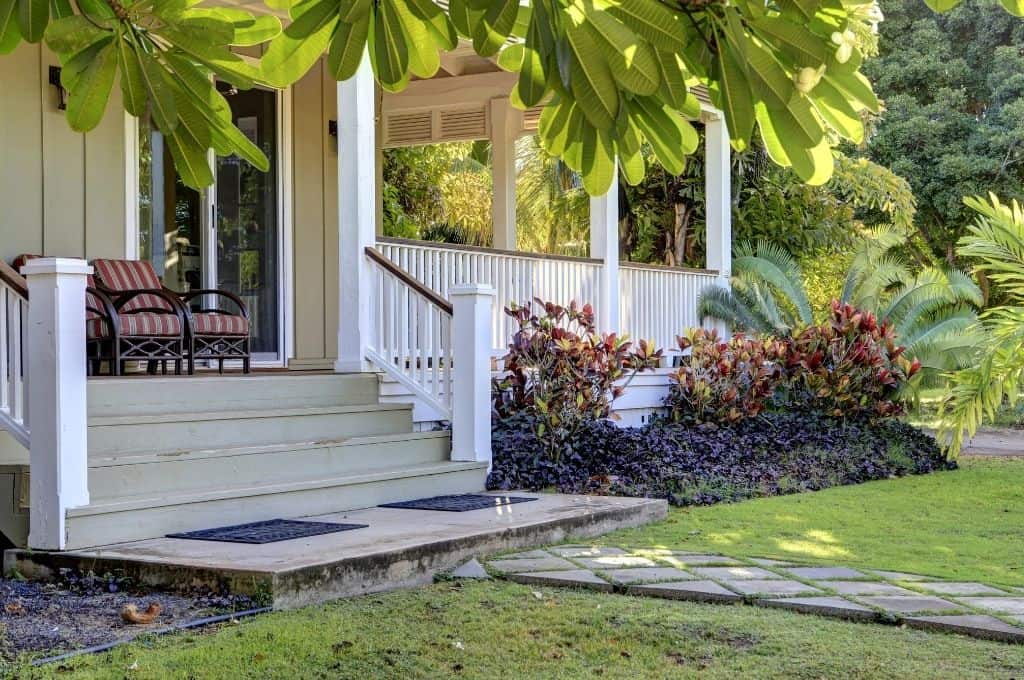
We’ve stayed in a vacation rental on Kauai with a toddler and 4-year old. It was exactly the right call for us. We wanted a quieter experience, a lawn for the little one to run around, and a full kitchen so we weren’t eating every meal out. It worked beautifully.
That’s the vacation rental sweet spot. Real space. A kitchen. The feeling of actually living in Hawaii instead of just passing through it.
A three-bedroom condo in Kihei might cost $350 to $400 per night, roughly the same as two hotel rooms, but with a kitchen, a living room, in-unit laundry, and a lanai. After a long day of exploring, that space matters.
Benefits of Staying in a Hawaii Vacation Rental
✅ Real space, not two hotel rooms with a shared wall
✅ A kitchen cuts your food costs dramatically. A basic breakfast for a family of four at a resort restaurant easily runs $80 to $120. Groceries cost a fraction of that.
✅ In-unit laundry means you can pack less and stay longer without running out of clothes
✅ A quieter, more residential experience away from the main resort areas
✅ Significantly cheaper for larger groups when the per-person math works in your favor
✅ Traveling with kids, pets, or both is just easier in a private home
Drawbacks of Staying in a Hawaii Vacation Rental
❌ Pool access varies depending on the rental you choose
❌ High one-time cleaning fees without daily housekeeping
❌ Quality and decor vary wildly with no brand consistency
❌ No front desk to call at 11 p.m. when something goes wrong
❌ In 2026, legal risk is a real and significant factor on several islands
What’s Really Cheaper: Hotel or Vacation Rental in Hawaii?
This is where most travelers get tripped up, because the advertised price is almost never the real price for either option.
According to the Hawaii Tourism Authority and Travel Weekly’s March 2026 analysis, the statewide hotel average daily rate in January 2026 was $383.
The statewide vacation rental average daily rate that same month was $534. Wait, vacation rentals are more expensive?
Not exactly. That higher vacation rental average reflects the fact that rentals are typically larger, multi-bedroom properties. When you split a $400 vacation rental among six people, the per-person math looks very different from two hotel rooms at $287 each.
Average Hawaii Hotel Costs by Category (Current Data)
| Category | Average Nightly Rate |
|---|---|
| Luxury | $721 |
| Upper Upscale | $302 |
| Upscale | $205 |
| Upper Midscale | $193 |
| Midscale and Economy | $197 |
By island, hotel average daily rates in January 2026 were:
- Maui: $546
- Kauai: $431
- Oahu: $287
- Big Island: strong growth trend
Here’s what those hotel prices don’t include: resort fees and parking. In Waikiki right now, resort fees run $35 to $72 per day at major properties.
Parking adds another $45 to $89 per day. The Hilton Hawaiian Village charges a $54 daily resort fee plus $72 for self-parking.
Turtle Bay on the North Shore adds a $52 daily resort fee plus $40 for parking. Plan to add $50 to $100 per night to any Hawaii hotel listed rate before you compare it to a vacation rental.
For vacation rentals, the hidden cost is the one-time cleaning fee, which ranges from around $100 for a modest studio to $370 or more for a larger home.
Unlike the hotel’s daily resort fee, it’s a fixed one-time charge. Which brings us to the most important money tip in this entire guide.
The Seven-Night Rule
A $300 cleaning fee on a three-night stay adds $100 per night to your effective rate. That same fee spread across a seven-night stay adds only $43 per night.
Don’t book a vacation rental for fewer than seven nights if saving money is your primary reason for doing it. On short trips, the cleaning fee math almost always wipes out the nightly rate advantage and a hotel’s consistent nightly pricing wins.
The Group Size Multiplier
For larger groups the vacation rental math gets really compelling. Two hotel rooms on Oahu at the current average of $287 per room costs $574 per night for a family of six.
A three-bedroom rental at $350 per night houses everyone for $224 less per night before a single meal is considered.
Over seven nights that’s over $1,500 in accommodation savings alone. Add the kitchen factor and that same family could realistically save $2,000 or more over the course of the week.
Bottom Line: If you’re a couple or solo traveler who plans to eat out, you’re unlikely to see significant savings with a vacation rental over a mid-range hotel.
For a family that will cook some meals at home and needs multiple bedrooms, a vacation rental can save you $1,500 to $2,500 over a week. That’s real money.
Planning the full picture for your Hawaii trip?
Start by picking the best time to go to Hawaii so your budget and availability line up with the right season, then use our Hawaii vacation rental laws guide to verify your rental is legal before you book. If you are still deciding which island fits your travel style, our best island in Hawaii guide breaks it down by experience and budget, and our 2026 Hawaii travel changes overview covers every new law, fee, and rule that affects where you stay this year.
The 2026 Tax Reality Every Hawaii Traveler Needs to Know

Here’s something that surprises a lot of travelers right now. As of January 1, 2026, Hawaii raised its statewide Transient Accommodations Tax to 11 percent. Governor Josh Green has been calling it the Green Fee, dedicated to climate resiliency and environmental protection across the islands.
Stack that on top of county taxes and Hawaii’s General Excise Tax, and the total effective tax burden on any Hawaii lodging comes out to about 18.5 percent.
That applies to hotels, resorts, Airbnb, and VRBO equally. A listed nightly rate of $200 is actually $237 before a single fee is added.
There’s no tax advantage to booking a vacation rental over a hotel anymore. The platforms are required to collect and remit these taxes on every booking.
The differentiation between the two models now lives entirely in the base price, the fees, and the experience.
Is Your Vacation Rental Actually Legal? (Island by Island)
This is the part of the 2026 conversation that most travel sites aren’t covering clearly enough, and it genuinely matters.
The legal landscape for vacation rentals has been completely redrawn across Hawaii. If you book an illegal rental and it gets shut down, the host faces fines. But you face displacement with very limited platform recourse.
Airbnb’s AirCover guarantee sounds comprehensive. In practice, during real disruptions, it frequently falls short because individual hosts control their own refund decisions regardless of platform policy.
We’ve heard directly from travelers who experienced this firsthand during major Kona storms, where hosts refused refunds even after Airbnb acknowledged the situation qualified under their major disruptive event policy.
The platform can set the policy, but the host controls the money.
Here’s where things stand on each island right now.
Oahu
Under Ordinance 22-7, known as Bill 41, residential properties outside designated resort zones cannot be rented for less than 90 consecutive days.
Legal short-term vacation rentals are limited to five resort zones: Waikiki, Ko Olina, Turtle Bay, Makaha, and Hoakalei. That charming North Shore cottage or Kailua beach house you found listed on Airbnb?
Unless it’s in one of those five zones or holds a legacy Non-Conforming Use Certificate, it’s not legal for a one-week vacation.
Fines for violations reach up to $10,000 per day. Worth noting: Civil Beat reported in July 2025 that Honolulu has largely failed to enforce this law against major platforms, which means illegal listings are still appearing and still bookable.
That enforcement failure does not protect you as the guest.
Verify any Oahu rental before you book at honolulu.gov/dpp/permitting/str. It takes two minutes and could save your entire trip.
Maui
Maui is the most important short-term rental story in Hawaii right now and most travelers haven’t heard it.
Bill 9, signed into law on December 15, 2025, phases out over 6,200 apartment-zoned vacation rentals on what’s called the Minatoya List.
These are condos that had been operating as vacation rentals since 2001 under a historical exemption despite being zoned residential. Bill 9 ends that.
West Maui properties on the Minatoya List must stop operating as vacation rentals by January 1, 2029. The rest of Maui by January 1, 2031.
There was a proposed lifeline through new H-3 and H-4 hotel zoning districts that could have saved around 4,500 of those units.
The Maui Planning Commission rejected that proposal on February 25, 2026. That door is essentially closed.
Hotel-zoned and resort-area properties on Maui are completely safe to book. Minatoya-listed condos are on a countdown clock and many are still appearing on booking platforms right now.
If you’re booking a Maui vacation rental, confirm it’s hotel-zoned or holds a valid permit not tied to the Minatoya List.
Kauai
Short-term rentals on Kauai are only legal within Visitor Destination Areas, mainly Princeville on the North Shore and the Poipu and Koloa area on the South Shore.
Outside those zones, rentals under 180 days are simply not permitted and no new permits are possible. This supply restriction is part of why Kauai’s vacation rental average daily rate hit $431 in January 2026. You’ll pay a premium, but the legal clarity within the VDAs is the highest of any island right now.
Big Island
The Big Island, governed by Ordinance 2018-114, remains the most permissive county in the state for short-term rentals.
It offers the broadest range of legal options and the least regulatory volatility. Coffee farm cottages near Kona, lava-view properties near Volcanoes National Park, quiet residential neighborhoods in Hilo, the Big Island has it all.
Just confirm your host holds a current STVR permit under the county’s 2025 annual registration requirement.
How These Options Really Compare
We have stayed in both resorts and vacation rentals across the islands, and the honest truth is that the decision almost always comes down to two things: how many nights you are staying and how many people are splitting the bill.
A vacation rental with a cleaning fee only makes financial sense when you spread that cost across at least seven nights – below that, a mid-range hotel wins on total price almost every time.
The legal landscape in 2026 adds one more real variable that did not exist before, and checking the TAT number in a listing before you book takes two minutes and could save your entire trip.
Airbnb vs VRBO: Which Platform Is Better for Hawaii?
Both platforms list Hawaii vacation rentals and many hosts list on both. Here’s what’s worth knowing before you search.
Airbnb generally has the largest total inventory with the broadest range of budget-friendly and smaller properties. Its search interface has improved significantly, though it still lags for complex multi-filter searches. VRBO, now owned by the Expedia Group, tends to have a stronger selection of larger homes and resort-community condos. If you’re looking for a three-bedroom-plus property or a condo within a resort community like the Westin Kaanapali on Maui, VRBO’s inventory typically skews more favorably. If you’re looking for a budget-friendly studio or a smaller unit, Airbnb likely has more options.
From speaking with multiple rental owners, larger homes tend to prefer listing on VRBO while smaller places prefer Airbnb. Many owners do both.
The best approach is to search both before committing. The same property listed on both platforms sometimes shows different nightly rates, different cleaning fee structures, or different cancellation policies. A few extra minutes of comparison can save $100 or more on the same booking.
5 Tips for Picking Your Hawaii Hotel
1. Location first, amenities second. Decide which activities and areas matter most before you book. On Maui the difference between staying in South Maui near Wailea versus West Maui near Kaanapali is significant in terms of beach conditions and drive times to major attractions.
2. Calculate the full fee stack before comparing. A hotel listed at $250 per night with a $55 resort fee, $50 parking, and 18.5 percent taxes is actually costing you around $420 per night. Always build out the full nightly cost before making any comparison.
3. Check restaurants nearby. Resort dining is excellent but expensive. If you plan to eat off-property sometimes, make sure walkable or easily driveable local options exist.
4. Assess the pool and beach setup carefully. Not every Hawaii hotel is truly beachfront. Use Google Maps satellite view to check exactly what the beach access looks like. Some Waikiki hotels require crossing a busy road to reach a public beach shared with everyone.
5. Check for hotel points and redemption value. Hawaii is one of the strongest redemption destinations in the major loyalty programs. Marriott Bonvoy, Hilton Honors, and World of Hyatt all have strong Hawaii portfolios. If you have points, run the math before paying cash.
6 Tips for Picking the Right Hawaii Vacation Rental
1. Verify legal status before everything else. Check for the TAT number in the listing. Every legal short-term rental in Hawaii is required by law to display its Transient Accommodations Tax ID number. No TAT number is an immediate red flag. Then use the county-specific verification tools: Oahu’s DPP eligibility map at honolulu.gov/dpp/permitting/str, VDA confirmation for Kauai, hotel zoning verification for Maui, and STVR permit confirmation for the Big Island.
2. Understand what resort community means for amenities. Many of the best vacation rentals in Hawaii are condos within resort communities that have shared pools, tennis courts, and beach access. The Kaanapali area on Maui, Princeville on Kauai, and Ko Olina on Oahu all have vacation rental condos within resort-level communities that deliver much of the hotel experience alongside the kitchen and privacy of a rental.
3. Use Google Maps satellite view before booking. A listing that says steps from the beach might mean a 50-meter walk across clean sand or a 400-meter walk through a parking lot and across a busy road. Check it yourself every time.
4. Read the checkout requirements in full. Many Hawaii vacation rentals require guests to strip beds, run the dishwasher, and take out trash before leaving. Decide honestly whether that fits your vacation mindset before you commit to a booking.
5. Confirm parking before you commit. If you’re renting a car, and outside of central Waikiki you almost certainly should be, confirm the rental includes a designated parking space that works for the size of vehicle you’re planning to rent.
6. Always pay by credit card through the official platform system. Never wire transfer, never Venmo, never Zelle outside the platform. Your credit card is your last line of protection if something goes wrong, and in Hawaii’s current STR environment, that protection matters.
How to Decide What’s Right for You (Hotel or Airbnd in Hawaii)
- Figure out your group size and trip length first, because those two factors determine which option will actually save you money before you look at a single listing.
- Build out the full nightly cost for any hotel you are considering by adding the resort fee, parking, and the 18.5 percent tax rate on top of the listed rate.
- For any vacation rental you are considering, divide the cleaning fee by the number of nights you are staying and add that to the nightly rate to get your true cost.
- If you are booking a vacation rental on Oahu, Maui, or Kauai, verify the TAT number in the listing and cross-check it with your island’s county verification tool before you pay anything.
- Use the Hawaii trip calculator to get a realistic picture of your total trip budget before lodging costs lock you in.
- If you have not settled on an island yet, that decision will shape everything else – our best island in Hawaii guide is a good place to start.
The Bottom Line: Hotel or Airbnb in Hawaii?
When choosing between a hotel or Airbnd in Hawaii, there is no single right answer here, and that is actually good news! Both options can lead to a great Hawaii vacation. The decision just comes down to a few honest questions about your group, your budget, and how you like to travel.
- Couples and solo travelers on shorter trips often do just as well, or better, with a mid-range hotel
- Families of four or more staying seven or more nights and planning to cook some meals at home will usually save more with a vacation rental
- Every traveler needs to account for resort fees, cleaning fees, and the 18.5 percent tax rate before comparing prices
- Vacation rental bookers on Maui, Oahu, and Kauai must verify legal status before paying a single dollar
Whatever you choose, go in with the full cost in front of you and the legal homework done. That one extra step is what separates a smooth Hawaii trip from a stressful one.
Still unsure if you’re planning Hawaii the right way?
A short 1-on-1 call can save you hours of research and help you avoid costly mistakes before you book.
Get Personal Trip AdviceEnjoyed this Post About Hotel or Airbnd in Hawaii? (Pin it to save it!)

FAQs for Hotel or Airbnb in Hawaii
Is it better to book a hotel or Airbnb in Hawaii?
Hotels work best for short stays, couples, and anyone who wants a pool and daily housekeeping without thinking about it. Vacation rentals work best for families of four or more staying at least seven nights – the kitchen and extra space can save $1,500 or more over the trip. In 2026, always verify a vacation rental is legally permitted before booking, since thousands of listings across Oahu, Maui, and Kauai are no longer legal for short stays.
Is $1000 enough for a week in Hawaii?
$1,000 for a week in Hawaii is workable for one person if flights and accommodation are already covered, but it is tight. That works out to roughly $143 per day for food, transportation, and activities – enough if you eat at food trucks and grocery stores, stick to free beaches and hikes, and rent a car through a budget platform. If $1,000 needs to cover a hotel or vacation rental too, it will fall short on most islands, where lodging alone averaged $287 to $546 per night in early 2026.
What is the 75-55 rule in Airbnb?
The 75/55 rule is a vacation rental investor tool, not an official Airbnb policy. It suggests a market is worth entering if existing listings show at least 75% occupancy over the next 30 days and 55% occupancy over the next 60 days – meaning demand is strong and the market is not oversaturated.
- Step 1: Go to Airbnb and search your target city or area.
- Step 2: Filter for properties similar to what you plan to list – bedrooms, guest count, property type.
- Step 3: Check individual listing calendars to see how many nights are already booked.
- Step 4: If most listings show 22 or more booked nights in the next 30 days and over 55% booked in the next 60 days, the market meets the benchmark.
Is $2000 enough for a week in Hawaii?
$2,000 for a week in Hawaii is realistic for one person if flights are already covered, and very tight but possible for two people who plan carefully. It works out to roughly $285 per day for one person, or $143 per day each for two – enough to cover a budget hotel or studio rental, grocery store meals, and free activities like beaches and hiking. If $2,000 needs to cover flights too, one person can make it work from the West Coast where fares can run $300 to $500 round trip, but it leaves little room for tours, dining out, or car rental.
- Lodging: Budget hotels and studio rentals on Oahu run $100 to $200 per night, the most affordable option among the islands.
- Food: Grocery stores, food trucks, and plate lunch spots keep daily food costs to $30 to $50 per person.
- Transportation: A rental car runs $50 to $80 per day before taxes and fees – skip it in Waikiki, but budget for it on any other island.
- Activities: Beaches, hiking trails, and most state parks are free; paid tours and snorkel excursions typically run $80 to $150 per person.
What is the average cost of a hotel room in Hawaii?
The statewide average daily hotel rate in Hawaii was $383 in January 2026, according to the Hawaii Tourism Authority – but that number alone does not reflect what you will actually pay. Resort fees of $35 to $72 per day and parking of $45 to $89 per day are charged on top of the listed rate at most major properties, and Hawaii’s lodging tax adds another 18.5 percent to everything.
- Oahu: $287 per night average
- Kauai: $431 per night average
- Maui: $546 per night average
- Big Island: Below statewide average with strong growth trend
- Resort fees and parking: Add $50 to $100 or more per night at most Waikiki and resort-area properties before comparing to vacation rentals.
RECOMMENDED POSTS

Ways You Can Help Those Affected by Hurricane Lowell
[dssb_sharing_buttons columns="5" icon_width="fixed" alignment="left" icon_color="#000000" use_custom_icon_size="on" icon_font_size="16px"...
Do You Need to Rent a Car in Hawaii? My Island-by-Island Answer
[dssb_sharing_buttons columns="5" icon_width="fixed" alignment="left" icon_color="#000000" use_custom_icon_size="on" icon_font_size="16px"...

Hawaii Reservations and Fees 2026: What You Need to Book
[dssb_sharing_buttons columns="5" icon_width="fixed" alignment="left" icon_color="#000000" use_custom_icon_size="on" icon_font_size="16px"...
Bryan Murphy is the creator of Hawaii's Best Travel and host of the Hawaii's Best podcast, a top-30 U.S. travel podcast with 700,000+ downloads and a 4.9-star rating from 280+ reviews on Apple Podcasts. A Certified Hawaii Destination Expert and member of the Hawaii Visitors & Convention Bureau, he helps visitors plan more meaningful trips to Hawaii with practical, respectful guidance. His work has been featured in Travel + Leisure, National Geographic, Yahoo!, Simple Flying, USA Today, Parents, and Fox.