Photo by Sean Mars via Wahi Pana
Wahi Pana on O’ahu: The Hawaiian Stories Behind Familiar Places
Before you scroll, I sometimes share links for Hawaii spots I genuinely recommend. No extra cost to you, it just supports the site. Read our affiliate disclosure for info.
Listen to the Full Podcast Episode:



You’ve probably seen Diamond Head. Maybe you’ve hiked it, driven past it, or stopped to take a picture. But how much do you know about its Hawaiian history?
There’s a public art project on Oʻahu helping visitors discover the stories behind places they might already be planning to visit.
In episode 267 of Hawaii’s Best Travel, I talk with Jennifer Santos, Executive Director of Honolulu’s Mayor’s Office of Culture and the Arts, about Wahi Pana and how it’s helping people experience familiar places differently.
In this episode, we cover:
- What Wahi Pana is and how it’s sharing Hawaiian history through public art installations across Oʻahu
- The Hawaiian stories behind Diamond Head (Lēʻahi), including poetry that reveals a side of this famous landmark many visitors never learn about
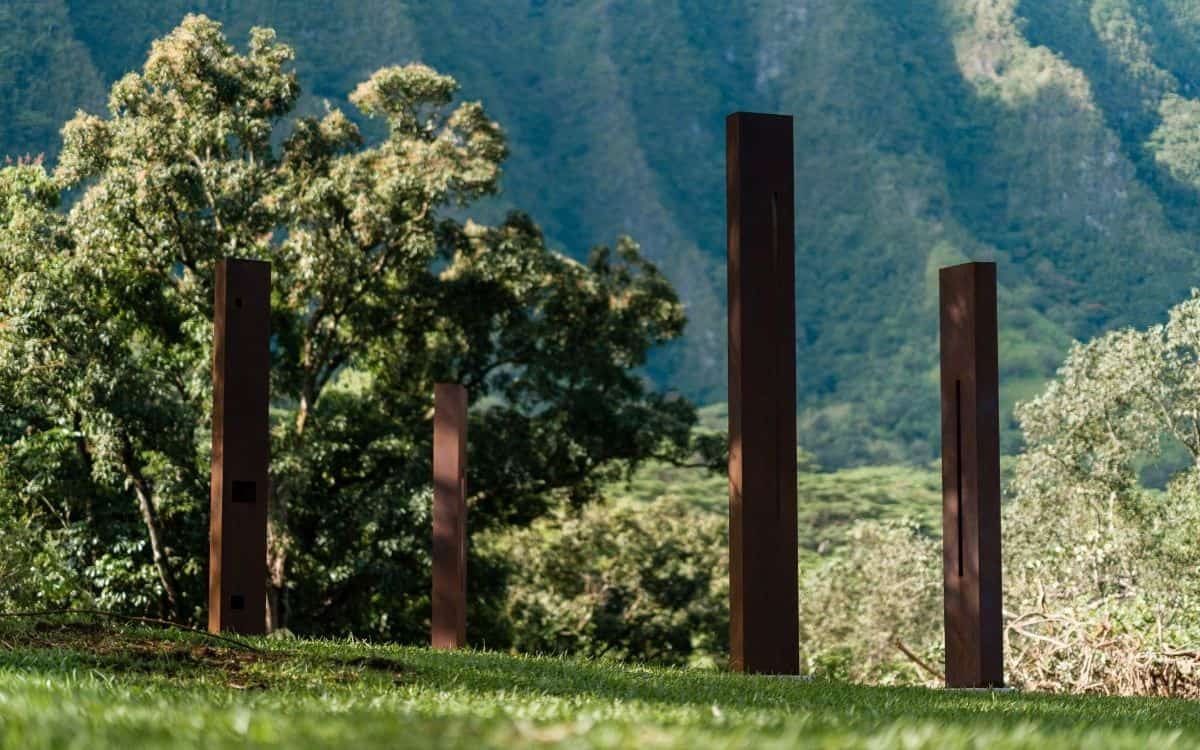
- The four viewing sculptures at Hoʻomaluhia Botanical Garden and how they help visitors see the Koʻolau Mountains differently
- Why Jennifer Santos believes understanding the history of a place can change how we experience it, whether we’re visiting for the first time or have lived there our entire lives
- How to find Wahi Pana’s 11 art installations around Oʻahu and use the Bloomberg Connects app to learn the stories behind them
Next step: Spend 10 to 15 minutes exploring WahiPana.com. Choose one installation, maybe at Diamond Head or Hoʻomaluhia Botanical Garden, and learn the story behind it. If you’re planning an Oʻahu trip, see if you can work that stop into your itinerary.
Has the podcast been helpful for you? Please leave a review here. Even one sentence helps! Consider including your social media handle so I can thank you personally!
Wahi Pana is a public art project led by Honolulu’s Mayor’s Office of Culture and the Arts.
The project brings together Native Hawaiian and local artists, historians, and researchers to share Hawaiian history through art installations around Oʻahu.
There are 11 installations featuring different forms of art, including sculpture, poetry, video, and signage.
During our conversation, Jennifer explains how many of the stories behind these places haven’t always been widely shared.
Wahi Pana gives people an opportunity to learn about the history and cultural significance of places they might otherwise visit without knowing much about them.
And it’s not just for tourists. Even people who have lived on Oʻahu their entire lives can discover stories about their communities they never knew.
Discovering Something New at Hoʻomaluhia Botanical Garden
I’ve visited Hoʻomaluhia Botanical Garden many times, but I didn’t even realize there was a Wahi Pana installation there.
At Hoʻomaluhia, artist Kaili Chun created four steel viewing sculptures that draw attention to the surrounding Koʻolau Mountains.
Each sculpture frames part of the landscape and encourages visitors to slow down and observe what’s around them.
The artwork helps connect those mountain views to the Hawaiian stories associated with the area.
That’s something I appreciated about my conversation with Jennifer. Even when you’ve visited a place several times, there’s still more to learn about it.

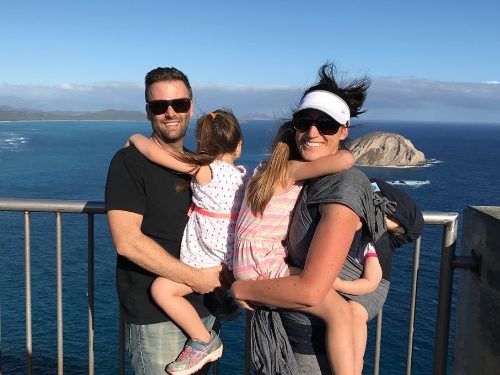
Enjoying the grounds at Ho’omaluhia Botanical Gardens on O’ahu | Photo by Bryan Murphy of Hawaii’s Best
The Hawaiian History Behind Diamond Head
Diamond Head is one of Oʻahu’s most recognizable landmarks. But its history goes far beyond the familiar view of the crater.
Lēʻahi is one of the Hawaiian names associated with Diamond Head, and Wahi Pana explores its history through poetry by Native Hawaiian poet Brandy Nālani McDougall.
Glass panels installed in parks around Lēʻahi feature excerpts from her poetry.
The work explores how people have understood Lēʻahi over time, from Native Hawaiian perspectives to its later military use and the landmark visitors recognize today.
One thing to know before visiting: these installations are located in parks surrounding Lēʻahi, not along the Diamond Head summit trail.

Photo by Lila Lee via Wahi Pana
How to Explore Wahi Pana on Oʻahu
If you’re planning a trip to Oʻahu, start with the official Wahi Pana website.
You’ll find information about the installations, the artists behind them, and where to experience the artwork.
Jennifer also recommends Bloomberg Connects, a free app that provides digital guides to Wahi Pana and other cultural experiences.
The installations also include QR codes that visitors can scan to learn more about the artwork and its history.
Before heading out, check each location’s visitor information. Some parks and attractions have their own hours, admission fees, or entry requirements.
Wahi Pana is a temporary project, with installations currently scheduled to remain through February 2028.
Whether you’re visiting Oʻahu for the first time or returning to a favorite place, it’s an opportunity to discover a story you might otherwise miss.
About Jennifer Santos & Wahi Pana
Jennifer Santos is the Executive Director of Honolulu’s Mayor’s Office of Culture and the Arts, which oversees the Wahi Pana project.
Through this work, Jennifer and her team collaborate with artists, historians, and cultural practitioners to share Hawaiian history through public art.
Explore Wahi Pana:
Related Hawaii’s Best Episodes
- The Untold Story of Waimea Valley
- What Native Hawaiian Voices Want You to Know Before Visiting
- How to Engage with Hawaiian Culture Responsibly with Kamaka Dias
Related Articles
More episodes:
Don’t Miss the Next Episode of Hawaii’s Best
Join us each week for practical Hawaii travel tips, local stories, and cultural insights to help you plan a better trip to the islands.
Please follow on your favorite podcast platform:




If Hawaii’s Best has helped you plan your trip, we’d be grateful if you left a review on Apple Podcasts.
Connect with Bryan
Looking for more Hawaii travel tips? Click here to browse all episodes of the Hawaii’s Best Travel podcast.
Transcript
267_Oahu’s Hawaiian History Is Hiding in Plain Sight (with Wahi Pana)
[00:00:00] Diamond Head Stories
[00:00:00] Bryan Murphy: Coming up on Huai is best.
[00:00:02] Jennifer Santos (Wahi Pana): Everyone loves taking pictures and posting. Like I can go beyond just like, oh, this is a pretty sunset, but where am I? You know, and what’s the story of this place?
[00:00:10] Bryan Murphy: You probably already know Diamond Head, maybe you’ve hiked it, maybe you’ve just stopped to take a picture, but how much do you actually know about the history of that place?
[00:00:18] Bryan Murphy: There’s a project on Oahu that’s helping tell the Hawaiian stories behind places visitors see every single day. Today, we’re talking about what those stories are, why they matter, and how you can experience them for yourself.
[00:00:32] Meet Jennifer Santos
[00:00:32] Bryan Murphy: Aloha, and welcome to Hawaii’s Best. I’m Brian Murphy, a Hawaii destination expert and your personal guide to planning a better Hawaii trip.
[00:00:40] Bryan Murphy: Through practical tips, local voices, and stories from the islands, I’ll help you make the most of your time in Hawaii and stay connected between visits. Today, I’m joined by Jennifer Santos. Jennifer is the executive director of Honolulu’s Mayor’s Office of Culture and the Arts. We’re talking about Wahipana.
[00:00:57] Bryan Murphy: It’s a public art project that helps share Hawaiian history and stories through installations around the island of Oahu. A lot of these are places you might already be planning to visit or have visited, including Diamond Head, Le’Ahi, or like Ho’omalahia Botanical Garden. In this episode, Jennifer shares the stories behind some of these places and how you can explore the installations for yourself on your next trip to Oahu.
[00:01:22] Bryan Murphy: Let’s go ahead and let’s talk story with Jennifer.
[00:01:30] Bryan Murphy: Jennifer, thank you so much for coming on Hawaii’s Best.
[00:01:33] What Is Wahipana
[00:01:33] Bryan Murphy: And to start, what is Oahipana? Specifically thinking about people visiting Oahu, why should someone visiting, like, even care about what’s going on with Oahipana?
[00:01:44] Jennifer Santos (Wahi Pana): Thank you so much for having me. And to everyone else.
[00:01:51] Jennifer Santos (Wahi Pana): I am the executive director of the Mayor’s Office of Culture and the Arts. Vahipana is a project of MoCA, which is our acronym for short, which is the output of a grant that we were awarded by Bloomberg Philanthropies. Bloomberg Philanthropies was started by one of the mayors of New York who wanted to dedicate opportunities for pressing civic issues to come to bear by way of public art.
[00:02:20] Jennifer Santos (Wahi Pana): And that’s exactly what Mahipana is. It’s something that we had put thought into at the time of application for the grant. It was actually right after COVID. And so we wanted to utilize this opportunity to give our visitors a more meaningful experience. For example, Ho’omaluhia was an area that was highly frequented even during COVID and became popular on social media and such.
[00:02:51] Jennifer Santos (Wahi Pana): That was the inspiration of, of one of our early sites, Ho’omaluhia Botanical Garden. The Wahipana Project is our way of utilizing contemporary art, partnering with native Hawaiian and local artists, as well as researchers, historians to take Hawaiian history, ancestral knowledge, place-based storytelling that has been sheltered, suppressed, redacted, if you will, over time, even commodified, and giving it a new breath of light through these art installations.
[00:03:29] Jennifer Santos (Wahi Pana): We were fortunately one of eight recipients. There were nearly 200 applicants across the continent that ha- had applied for the grant, and Mocha was awarded $1 million over the course of three years for us to be able to put this project together.
[00:03:47] Bryan Murphy: That’s awesome.
[00:03:48] Art Installations Explained
[00:03:48] Bryan Murphy: So for someone who’s trying to visualize, I know you mentioned Homa Luhia Botanical Garden, which is honestly one of my family’s favorite places when we visit, what exactly, like, what can visitors expect?
[00:04:02] Bryan Murphy: So just kind of paint a picture, like what is it, like what type of art installations are behind some of these places that people already visit?
[00:04:10] Jennifer Santos (Wahi Pana): We actually take a lot of pride in the fact that we were able to showcase a myriad of different mediums o- of art. So this project is in partnership with a lot of intercity departments as well as external organizations.
[00:04:29] Jennifer Santos (Wahi Pana): For example, Ho’oma Luhia is an area that is overseen by the Department of Parks and Recreation. And most of our installations are on park and recreation ground. They’re all in public spaces. Particularly, there’s a cordon steel structure that’s utilized for kilo, which is the Hawaiian term for observation.
[00:04:53] Jennifer Santos (Wahi Pana): And it oversees, it’s like a looking hole you can utilize to see the beautiful range of the Ko’lo mountains behind it. That particular installation talks about the significance of each of the four ku’u or each of the four mounds and what they mean to that particular place. The different types of installations vary from signage to video to poetry and even the bus.
[00:05:26] Jennifer Santos (Wahi Pana): We wrapped one of our city buses in handymans, so it’s movable art.
[00:05:32] Bryan Murphy: That’s cool. Yeah.
[00:05:33] Why This Matters
[00:05:33] Bryan Murphy: Well, I’m curious just personally, like how you got involved in all this, what interests you in this particular project, why it matters so much to you?
[00:05:42] Jennifer Santos (Wahi Pana): Living here on O’ahu and having a Mo’oku’oha or a Native Hawaiian genealogy in my family brings up, we say kulana and kuleana.
[00:05:55] Jennifer Santos (Wahi Pana): So it’s first off a role that I play, being a mother who is raising two native Hawaiian children, to a person who has the honor of leading an office of culture and art, to being in community. So that’s kind of like the role. The kuleana is the responsibility. I have an obligation to utilize my different roles to educate and share and partner and collaborate with the experts who have years and years generational on generation of knowledge that, again, has been suppressed, redacted, filtered over time.
[00:06:40] Jennifer Santos (Wahi Pana): Because the more we tell these stories of place and the more we educate either at the Pico or at the center, native Hawaiians to Kama’aina, people who are generation and generation of this place, but maybe not native Hawaiian, to settlers, from people who’ve been here for a short time to like a prolonged time, or maybe visitors who are just having a week of time here.
[00:07:06] Jennifer Santos (Wahi Pana): There is so much to tell and there is such a deeper opportunity to have a more immersive and authentic experience by understanding place-based storytelling. And there’s so many stories of this place to be told. For me personally, over time, the more we share, the more people will make either our conscious or even unconscious because it just becomes an innate way of life or how they move.
[00:07:33] Jennifer Santos (Wahi Pana): It will eventually build a sense of reciprocity. So people are going to feel vested, like, “Oh, you know this place that I grew up for, you know, all my life and my parents grew up and my grandparents grew up, like I had no idea that this was a place that now we see all the, you know, the schools and the buildings and, and the grocery stores, but this used to be the land of plentiful fishing and the fishing that you could obtain through these oceans that surround us could feed an entirety of a community and then s – like those stories are so critical to understanding and developing that greater sense of identity, that greater sense of stewardship, and really appreciation for where we are, how we can take care of the land, how we can be good stewards of the land, and, and how we, and how we can really make this a living, breathing culture by telling these stories.
[00:08:29] Bryan Murphy: I love that. Thank you for sharing that.
[00:08:32] Leahi Diamond Head Spotlight
[00:08:32] Bryan Murphy: And I wonder if you can share maybe a, a popular place on Oahu that a lot of visitors know. I know you mentioned the bus, you mentioned Homa Luhia, but is there another story behind another popular spot on Oahu?
[00:08:47] Jennifer Santos (Wahi Pana): Yeah. One of the most well-known internationally and beyond places when you think of Hawaii or O’ahu specifically is Diamond Head or Leyahi, which the traditional name presents.
[00:09:04] Jennifer Santos (Wahi Pana): And so one of the Bahipana installations highlights some of the layered complexities that come with the history of Leyahi, and it’s done by way of a poetry excerpt, which was written by Brandy Nalani McDougal, who was the last Hawaii poet laureate. And she has a 40 stanza poem by the name of Leahi, which she took certain parts of, and we have them exemplified by way of glass paneling in parks that surround the Leahi area.
[00:09:44] Jennifer Santos (Wahi Pana): And it’s a beautiful representation depending upon where you stand. There’s poetry, there’s a or a hook, like a fishing hook, and you can actually, depending on where you stand, see the hook catch the peak of leiahi. And the fishing hook is a nod to that being one of the places that had plentiful fish, tuna, to be exact.
[00:10:11] Jennifer Santos (Wahi Pana): Again, the surrounding areas would be though of so differently as how they’re represented now with all of the development. And then also there’s an element of the military use of leiahi that is revealed through the poetry. And so that’s a pretty strong statement and impactful story that a lot of people don’t understand, but knowing a little bit about that will add to the experience of when you actually get to see it or view it from afar.
[00:10:39] Visitor Versus Tourist
[00:10:39] Bryan Murphy: Touching on specifically for visitors, you know, how can knowing these stories of a place, how can that make someone’s trip more meaningful and impactful?
[00:10:51] Jennifer Santos (Wahi Pana): To know that you’re going to a place and it represents so much more depth than that which lies on the surface, you’re gonna naturally be inclined to like take more of that with you so that you continue the storytelling.
[00:11:03] Jennifer Santos (Wahi Pana): Everyone loves taking pictures and posting. Like I can go beyond just like, oh, this is a pretty sunset, but where am I? You know, and what’s the story of this place? I feel like there is an open space for that, that a lot of people are looking to fill with that meaning that you mentioned, that intention, that significance.
[00:11:22] Jennifer Santos (Wahi Pana): It takes a traveler to a- another level when the experience is, is guided, informed, and educated.
[00:11:31] Bryan Murphy: The definition or the term visitor to tourists, do you see a distinction in that, in identifying a visitor and tourist?
[00:11:40] Jennifer Santos (Wahi Pana): Through this project, something that I often say when I describe it is that you can be of place and still be a visitor.
[00:11:48] Jennifer Santos (Wahi Pana): Because when you’re a visitor, you’re, you’re seeing something through a particular lens, whether you’re visiting from a foreign place or whether you’re a visitor from down the street, right? It’s all about perspective. This project appeals to all of those concentric circles that, that we mentioned earlier.
[00:12:09] Jennifer Santos (Wahi Pana): So a visitor could be someone who has multiple generations here, but didn’t have access to those stories, to those significant gems of information that tie them to this land. And so very much as part of our programming, we go into the local communities that are surrounding the different installations.
[00:12:31] Jennifer Santos (Wahi Pana): We go into the schools, we go into the different people who have had years and years of residents, and they feel at times that they are a visitor because they’re learning new stories of their home that they didn’t have access to previously.
[00:12:48] Future Expansion Plans
[00:12:48] Bryan Murphy: I’m sure you envision the project to even grow, expand beyond what it currently is.
[00:12:54] Bryan Murphy: Are there other places that you have on a list, your team has on a list for expanding Vahipana? Are you able to share maybe another spot that you’re hoping to, to highlight?
[00:13:05] Jennifer Santos (Wahi Pana): I would love for us to be able to have more representation in parts of the islands that are not currently touched. We have 11 different core installations and a good amount of those are more centered in the Kona district of the island, which is more like in the Honolulu area.
[00:13:28] Jennifer Santos (Wahi Pana): We have a few scattered around Haleiwa, Kahe, North Shore, West Side, and then Ho’omagohia, as we mentioned before, towards the windward side. The next expansion of Vahipana will be at the which is an area which has all of the terraces and, and has different variety of kalo thriving and has had a concerted effort in removing invasive species and re-indigenizing native species to help with the coastline preservation and all of those magnificent things.
[00:14:03] Jennifer Santos (Wahi Pana): But we wanna be able to utilize the idea of taking contemporary art and different mediums and modes of art as being a symbolism of pulling people in and amplifying those stories. And so we’ll be partnering with the organization there to understand what that looks like so that we can have this demarcation of Wahipana specifically there rooted in Ahukwa.
[00:14:33] Bryan Murphy: Awesome.
[00:14:33] How To Explore Wahipana
[00:14:33] Bryan Murphy: So how can people say they’re planning a trip right now, how can they learn more about Wahipana? And then for those who are on island, how can they learn more?
[00:14:44] Jennifer Santos (Wahi Pana): I invite everybody to take a look at our website. It’s wahipana.com, W-A-H-I-P-A-N-A. Our Instagram handle is the same at Bahipana on social media.
[00:14:58] Jennifer Santos (Wahi Pana): This is really a unique thing. By way of the Bloomberg Philanthropies connection, they have an app which is called Bloomberg Connects. And beyond Vahipana, but inclusive of Vahipana, it will take you towards all of the different culture and art activations in the space that you are in. It will pick up your location, it’ll bring you that, that offering if you’re not quite sure of what it is you’re looking for, or you can type in Vahipana and you can go to each of the installations within or the collective of the Vahipana, and you can be on site.
[00:15:36] Jennifer Santos (Wahi Pana): All of our installations have the QR code where you can click this, by the way. But it will give you that guided experience. The uniqueness is that it also defers to the native language that is already in operation on your phone. So if you’re a visitor from Japan, for example, like when you pull up the app, everything that you’re reading is gonna, is gonna be in Japanese.
[00:15:56] Jennifer Santos (Wahi Pana): And so it’s a nice way to be able to have that connection to where I’m here, I’m clicking, this is what it’s about. And so I encourage you, if you’re planning a visit or like you said, if you’re here on island to check out those sources, our Instagram also will have all of the different programming that we do for the installations.
[00:16:18] Jennifer Santos (Wahi Pana): And so if you happen to come during a time where we have an event, please come see us because we have, oftentimes the artists do talk stories, panel interaction, activations. And so I encourage you to come and, and visit and learn and explore and be curious about this wondrous place of.
[00:16:40] Bryan Murphy: Jennifer, thank you so much for coming on today.
[00:16:44] Bryan Murphy: Appreciate it. Mahalano. Mahalo.
[00:16:47] Final Takeaways
[00:16:47] Bryan Murphy: Something that I really wanted to highlight what she mentioned, when we visit a place, it’s easy to take a picture, enjoy the view, and just move on. But what about the story of that place, the history of that place? And that’s what I really appreciate about Vahipana. It gives us an opportunity to learn something we might otherwise just simply miss.
[00:17:06] Bryan Murphy: So if you’re heading to Oahu, check out vahipana.com and you can learn more about the installations and where you can find them. I’ll have the link in the show notes below. And if you visit one, I’d love for you to tell me about it. Send me a message on Instagram at hawaiis.best and let me know what installation you visited and what you learned from it.
[00:17:24] Bryan Murphy: And until next time, as always, live with Aloha.
RELATED PODCASTS

Do You Need to Rent a Car in Hawaii? My Island-by-Island Answer
[dssb_sharing_buttons columns="5" icon_width="fixed" alignment="left" icon_color="#000000" use_custom_icon_size="on" icon_font_size="16px"...
How Early Should You Plan a Hawaii Trip? What to Book and When
[dssb_sharing_buttons columns="5" icon_width="fixed" alignment="left" icon_color="#000000" use_custom_icon_size="on" icon_font_size="16px"...

Do You Need a Real ID to Fly to Hawaii?
This post may contain affiliate links, meaning I earn a small commission if you use the links. View our Privacy Policy and for more.Do You Need a...
Bryan Murphy is the creator of Hawaii's Best Travel and host of the Hawaii's Best podcast, a top-30 U.S. travel podcast with 700,000+ downloads and a 4.9-star rating from 280+ reviews on Apple Podcasts. A Certified Hawaii Destination Expert and member of the Hawaii Visitors & Convention Bureau, he helps visitors plan more meaningful trips to Hawaii with practical, respectful guidance. His work has been featured in Travel + Leisure, National Geographic, Yahoo!, Simple Flying, USA Today, Parents, and Fox.