
Leave Hawaiʻi Better Than You Found It: Help Grow a Native Forest
This article is sponsored by Terraformation. Full disclosure.
What if the best souvenir from your Hawaiʻi trip was a forest you’re helping to grow? Supporting native forest restoration on Hawaiʻi Island is one way to care for the islands beyond your visit.
Terraformation offers a forest restoration program that plants native and canoe species right here on Hawaiʻi Island. You can choose your own way to leave Hawaiʻi better than you found it, with one-time or ongoing tree-planting subscription support options.
Many tree-planting programs end with just putting a tree in the ground. Terraformation’s restoration program is different: it covers the work in the nursery from seed to seedling, then planting in the tree’s native Hawaiian habitat, and finally the years of care that follow.
You can start supporting native Hawaiian forests whenever it works for you: before your trip, after you get home, or even if your Hawaiʻi trip is still in the planning phase.
TL;DR
Supporting native forest restoration is a meaningful way to give back to Hawaiʻi beyond your trip.
Terraformation’s native forest restoration program helps fund the full process, from native seed collection to long-term tree care.
Why it matters: Native forests help capture fresh water, reduce erosion, and protect habitat for native plants and wildlife.
Cost: One-time, monthly, and yearly plans. You choose your own level of support: $25/month or $250/year are the most popular, with $25 supporting the full lifecycle of one native tree. Where: Your trees are being planted at ʻIole in North Kohala on Hawaiʻi Island.
How native forests protect the Hawaiʻi you visit
Whether you’re hiking a trail or driving through the mountains, Hawaiʻi’s forests shape the scenery around you. And their role extends far beyond the view.
Healthy native forests capture rainfall and help replenish underground water supplies.
Their roots also hold soil in place, which helps reduce erosion and the amount of sediment that can eventually reach streams and coral reefs.
According to Hawaiʻi’s Department of Land and Natural Resources, nearly half of the state’s native forests have been lost. Invasive mammals and non-native plants continue to threaten what remains.
That Mauka to Makai (mountain-to-ocean) connection is easy to miss as a visitor. The forest, freshwater, soil, native wildlife, streams, and reefs aren’t separate things.
They’re connected.
Restoring a native forest helps rebuild an ecosystem and restore the ecological connections that sustain it.
How tourism affects the land
Hawaiʻi welcomed 9,642,991 visitors in 2025, according to the state’s Department of Business, Economic Development & Tourism.
That’s millions of people using water and energy, driving local roads, and spending time around beaches, trails, reefs, and other natural areas.
Mālama ʻāina means caring for the land. It’s a Hawaiian value built around the relationship between people and ʻāina and the responsibility to care for it.
I don’t think that has to be complicated for us as visitors.
Supporting native forest restoration is one way to put that idea into practice, including after you’re back home.
What your support helps fund
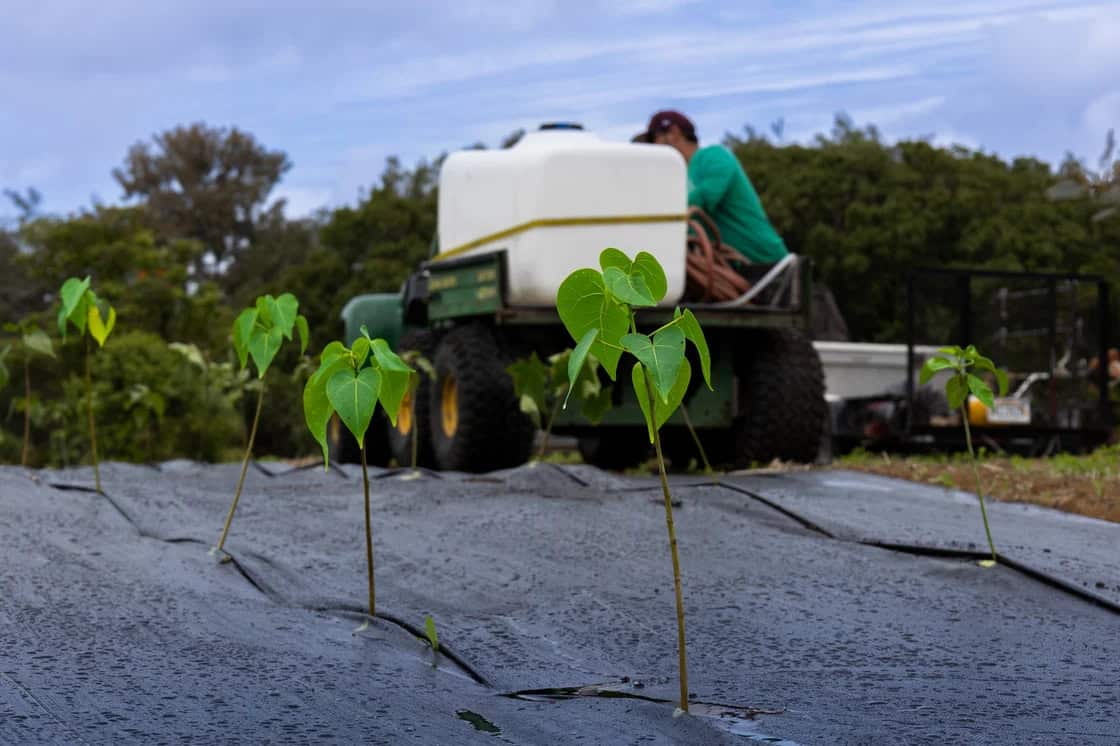
Terraformation’s program supports the work that gives young trees a chance to become an established forest.
A native tree can spend months in a nursery before it’s ready to go into the ground. The restoration site has to be prepared, and the work continues long after planting.
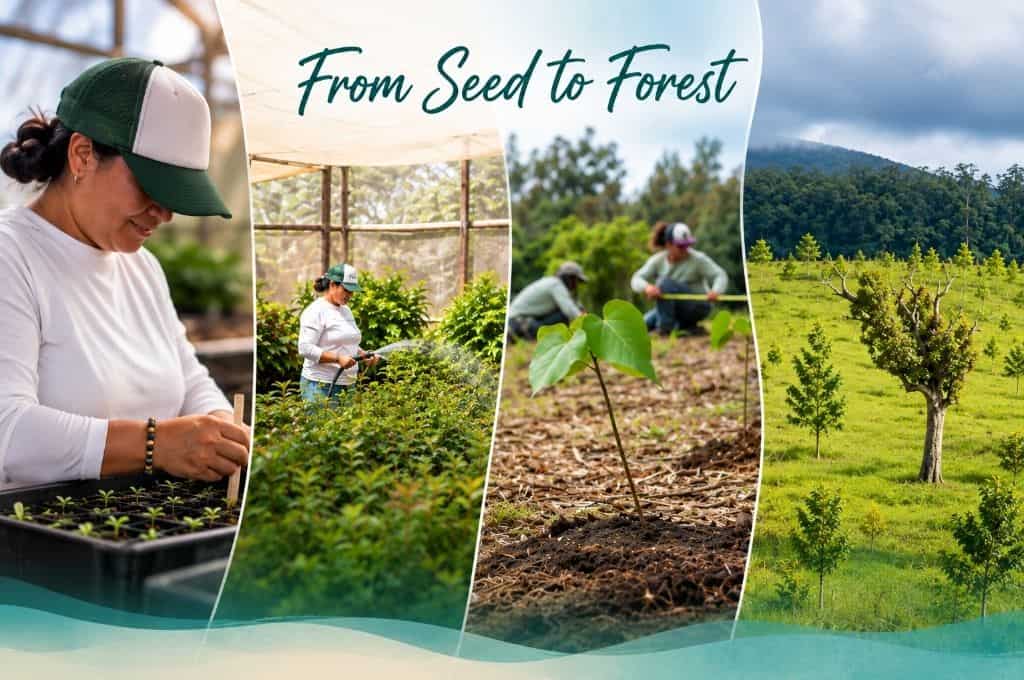
According to Terraformation, their restoration program helps fund the full process:
From seed to forest
What the Subscription Funds
Native forest restoration takes more than planting a tree. Here’s what happens from seed collection through long-term care.
-
Seed collection
Teams gather seeds from native trees during the appropriate seasonal windows.
-
Nursery care
Seedlings are watered, monitored, and gradually prepared for outdoor conditions.
-
Site preparation
Crews clear invasive vegetation and protect young trees from grazing animals.
-
Planting
Trees are matched with the conditions of the site and planted at the appropriate time.
-
Long-term care
Teams continue watering, weeding, monitoring, and checking survival as the forest develops.
What the Program Funds
Here’s how the restoration team cares for trees at each stage, from seed collection through long-term care.
- Seed collection: Teams gather seeds from native trees during the appropriate seasonal windows.
- Nursery care: Seedlings are watered, monitored, and gradually prepared for outdoor conditions.
- Site preparation: Crews clear invasive vegetation and protect young trees from grazing animals.
- Planting: Trees are matched with the conditions of the site and planted at the appropriate time.
- Long-term care: Teams continue watering, weeding, monitoring, and checking survival as the forest develops.
Long-term care is arguably one of the most important parts of the process. Establishing a forest takes years, and continued care helps young trees survive and grow.
Terraformation’s focus is on restoring a functioning, biodiverse forest rather than simply counting how many trees go into the ground.
How much does the program cost?
Terraformation offers monthly plans from $5 to $50, along with annual and one-time options.
The company says $25 represents the cost of supporting one native tree through the full restoration process, from seed collection to long-term care.
If you choose a subscription with a smaller monthly amount, your contribution adds up over time until it reaches that threshold.
So a $5 subscription doesn’t pay for a cheaper or partially cared-for tree. It just takes longer for those contributions to add up to the cost of fully supporting one.
Where the trees are planted
Trees supported through the program are planted at ʻIole in North Kohala on Hawaiʻi Island.
ʻIole is a nonprofit, place-based research and education center working to restore the Hapahapai watershed.
Local seed collectors gather seeds from surviving native trees in the area, helping the restoration team grow species suited to that particular place.
Students from the Kohala community also use the site for hands-on, ʻāina-based education. Restoration should connect to the place and the people caring for it.
Where is ‘Iole located?
Which species are planted
Supporters contribute to the forest as a whole rather than selecting individual trees.
The restoration team determines which mix of native species will best support each part of the site. The species below include some of the trees supported through the restoration program at ʻIole, as well as trees Terraformation plants across its other projects in Hawaiʻi.
| Tree | Why It Matters |
|---|---|
| Koa Acacia heterophylla subsp. koa | Fixes nitrogen in depleted soil and provides canopy for native birds. |
| ʻŌhiʻa lehua Metrosideros polymorpha | A foundational Hawaiian forest tree capable of colonizing bare lava. |
| Kamani Calophyllum inophyllum | A coastal canopy tree with fragrant flowers and glossy leaves. |
| Milo Thespesia populnea | A salt-tolerant tree valued in traditional Hawaiian woodworking. |
| Kou Cordia subcordata | Produces orange flowers and wood historically carved into bowls and utensils. |
| Kukui Aleurites moluccana | Hawaiʻi’s official state tree and a fast-growing source of shade. |
A healthy forest supports a diverse mix of species rather than a large number of the same one. Those species then interact with the soil, water, and wildlife as part of a connected ecosystem.
When to start
There isn’t one right time.
Start anytime
Before your trip
Make it part of how you’re thinking about giving back before you arrive.
During your trip
Maybe a hike or conversation shifts how you see Hawaiʻi’s forests and watersheds.
After your trip
Keep supporting restoration work after you’re back home.
Without a trip planned
You don’t have to be heading to Hawaiʻi to participate.
Your connection to Hawaiʻi doesn’t necessarily start when your plane lands or end when you fly home.
Terraformation says supporters receive monthly email updates and access to a dashboard where they can follow the restoration process from seed collection and nursery care through planting and forest establishment.
Seeds have to be collected. Seedlings have to grow. Land has to be prepared. And after a tree is planted, someone still has to care for it.
If you’d like to support that kind of long-term work, you can see Terraformation’s current options below.
FAQs about Terraformation
What does Terraformation’s restoration program pay for?
All plans help fund the full restoration process, including native seed collection, nursery care, site preparation, planting, and long-term monitoring and care. The goal is to support a healthy native forest, not just plant a tree and walk away.
How much does it cost?
Terraformation offers monthly plans from $5 to $50, along with annual and one-time options. A $25 monthly subscription supports the full lifecycle of one native tree. Lower monthly amounts build over time until they reach the amount needed to fully support a tree.
Where are the trees planted in Hawaiʻi?
Trees supported through the program are planted at ʻIole in North Kohala on Hawaiʻi Island. The restoration work there includes native forest recovery and ʻāina-based education involving students from the Kohala community.
Can I choose which native tree is planted?
No. Supporters grow a biodiverse forest as a whole rather than choosing a specific tree, although every tree is tracked with precise species information and GPS coordinates. The restoration team decides which mix of native species is best suited for each part of the site.
When can I start participating?
You can start before your Hawaiʻi trip, during your visit, after you return home, or even if you do not have a trip planned. Supporters will receive monthly updates and access to a dashboard showing the restoration process.
RECOMMENDED POSTS
Our Oahu Family Itinerary: 7 Nights in Ko Olina
[dssb_sharing_buttons columns="5" icon_width="fixed" alignment="left" icon_color="#000000" use_custom_icon_size="on" icon_font_size="16px"...

Hawaii Vacations Are Getting Shorter: Is That Bad?
[dssb_sharing_buttons columns="5" icon_width="fixed" alignment="left" icon_color="#000000" use_custom_icon_size="on" icon_font_size="16px"...

Renting a Car in Hawaii? An AI Scanner Doesn’t Replace Your Own Photos
[dssb_sharing_buttons columns="5" icon_width="fixed" alignment="left" icon_color="#000000" use_custom_icon_size="on" icon_font_size="16px"...
Bryan Murphy is the creator of Hawaii's Best Travel and host of the Hawaii's Best podcast, a top-30 U.S. travel podcast with 700,000+ downloads and a 4.9-star rating from 280+ reviews on Apple Podcasts. A Certified Hawaii Destination Expert and member of the Hawaii Visitors & Convention Bureau, he helps visitors plan more meaningful trips to Hawaii with practical, respectful guidance. His work has been featured in Travel + Leisure, National Geographic, Yahoo!, Simple Flying, USA Today, Parents, and Fox.